Our Picks at a Glance
- 1
 Check Price →
 - 2
 Check Price →
Best for Sensitive & Allergy-Prone Scalp
Vanicream Shampoo for Sensitive Skin (12 fl oz) - 3
 Check Price →
Best Sulfate-Free Dandruff Pick
Head & Shoulders BARE Soothing Hydration Anti-Dandruff Shampoo, 1% Pyrithione Zinc (13.5 fl oz) - 4
 Check Price →
Best for Scalp Psoriasis
MG217 Psoriasis Shampoo and Conditioner with 0.5% Coal Tar (8 fl oz) - 5
 Check Price →
Best for Thick Scale
Nizoral Psoriasis Shampoo & Conditioner with Salicylic Acid and Tea Tree Oil (11 oz) - 6
 Check Price →
The Short Version
- Identify the cause first. Flakes with oiliness suggest seborrheic dermatitis; itch after a new product suggests allergy; thick silvery plaques suggest psoriasis.
- CeraVe Hydrating Anti-Dandruff Shampoo is our best overall pick: pyrithione zinc for the most common cause of itch in a gentle, barrier-friendly base.
- If you react to products, choose a fragrance-free formula like Vanicream and avoid tea tree, essential oils and heavy scents.
- For scalp psoriasis or thick scale, coal tar (MG217) and salicylic acid (Nizoral Psoriasis) are the over-the-counter options with the most history.
- See a dermatologist if itch comes with hair loss, pain, pustules or spreading plaques, or if four weeks of the right shampoo has not helped.
On This Page · 12 sections
The best shampoo for itchy scalp depends entirely on why your scalp itches, and that is where most people go wrong. They grab the strongest-smelling, tingliest shampoo on the shelf, or a fancy scalp treatment loaded with essential oils, when their problem is a fragrance allergy that needs the opposite. Or they switch to a gentle, moisturizing shampoo for what they assume is dry scalp, when the flakes are actually seborrheic dermatitis that needs an antifungal. An itchy scalp is a symptom, not a diagnosis.
This guide is organized around the four common causes: dandruff and seborrheic dermatitis, contact dermatitis from hair products or dye, scalp psoriasis, and dry, irritated skin. It is deliberately broader than our best ketoconazole shampoo guide, which goes deep on dandruff and the antifungal options; if you already know flaking dandruff is your problem, start there. It also differs from our oily hair and sulfate-free guides, which are about everyday cleansing rather than relieving an itch. We also flag the signs that mean an itchy scalp needs a dermatologist rather than a new bottle.
We ranked the products below on whether their active ingredients match a specific cause of scalp itch, the strength of the evidence behind those ingredients, how gentle the base formula is, fragrance and common allergens, value, and patterns in verified buyer feedback. This is a research-based ranking, not hands-on testing, and every pick links to its exact Amazon listing.
What Is Causing Your Itchy Scalp?
Dandruff and seborrheic dermatitis are the most common causes by far. They sit on the same spectrum: dandruff is the mild, non-inflamed version with small white or grayish flakes, while seborrheic dermatitis adds redness, greasy yellowish scale and itch, sometimes spreading to the eyebrows, sides of the nose and behind the ears. Both are linked to Malassezia, a yeast that lives on everyone's scalp and feeds on sebum, and both tend to flare with stress, cold weather and infrequent washing.
Contact dermatitis is the second big category. Irritant contact dermatitis comes from products that are simply too harsh, while allergic contact dermatitis is an immune reaction to a specific ingredient, such as a fragrance, a preservative, a surfactant or a hair dye chemical. The giveaway is timing: itch that begins or worsens after a new product, salon visit or dye job, often with redness along the hairline, ears or neck where product runs.
Scalp psoriasis causes well-defined, thick, silvery-white plaques that can extend past the hairline onto the forehead, neck or behind the ears. It is often itchy, can bleed if picked, and frequently appears alongside psoriasis elsewhere, such as the elbows, knees or nails. Plain dry scalp, by contrast, produces fine, small, dry flakes and a tight feeling, often in winter or after hot showers and harsh shampoos, with little redness.
Less common causes matter too. Head lice cause intense itch, especially at the back of the head and behind the ears. Folliculitis produces itchy or tender bumps around hair follicles. Fungal infection of the scalp, mostly in children, causes scaly patches with broken hairs. And some scarring hair loss conditions begin with itch or burning. These need a doctor, not a shampoo swap.
| Typical clues | Shampoo to try | |
|---|---|---|
| Dandruff / seborrheic dermatitis | Flakes, greasy scale, redness, worse with stress | Pyrithione zinc, ketoconazole, selenium sulfide |
| Contact dermatitis | Itch after a new product or dye, hairline redness | Fragrance-free, minimal formula |
| Scalp psoriasis | Thick silvery plaques, past hairline, nails or elbows | Coal tar, salicylic acid |
| Dry scalp | Fine dry flakes, tightness, little redness | Gentle shampoo, lukewarm water |
| Lice, infection, scarring conditions | Nits, pustules, broken hairs, hair loss | See a doctor |
Matching the Active Ingredient to the Cause
For dandruff and seborrheic dermatitis, the over-the-counter actives with the strongest track records are ketoconazole, selenium sulfide and pyrithione zinc, all of which target Malassezia. Pyrithione zinc is the gentlest everyday option, selenium sulfide is a step stronger, and ketoconazole is often the most effective for stubborn cases. We compare them in detail in our best ketoconazole shampoo guide, so we will not repeat that here.
For scalp psoriasis, coal tar and salicylic acid are the main over-the-counter tools. Coal tar slows the rapid skin cell turnover that builds plaques and calms itch, while salicylic acid softens and lifts thick scale so it can be washed away and other treatments can reach the skin. Many people use both, alternating between them or using salicylic acid first. Moderate to severe scalp psoriasis usually needs prescription treatment.
Contact time matters for every medicated shampoo
For contact dermatitis, the key is removing the trigger, so the right shampoo contains as little as possible: no fragrance, no essential oils, no botanical extracts, and minimal preservatives. That is why a plain product like Vanicream often outperforms an expensive soothing scalp formula for allergic itch.
For simple dry scalp, there is no active to add. Use a gentle shampoo, lukewarm water and a conditioner, and avoid stripping, heavily scented or clarifying formulas. Contact time matters for every medicated shampoo: massage it into the scalp and leave it for a few minutes before rinsing, as the label directs, rather than washing it straight out.
The 6 Best Shampoos for Itchy Scalp
Each pick below targets a specific cause of scalp itch. Start with the one that matches your symptoms: an anti-dandruff shampoo for itch with flakes, a fragrance-free shampoo for suspected product reactions, and coal tar or salicylic acid for psoriasis and thick scale.
CeraVe Hydrating Anti-Dandruff Shampoo, Itchy Scalp Treatment (12 oz)
Pyrithione Zinc Anti-Dandruff Shampoo
Best for: Itch with flaking from dandruff or mild seborrheic dermatitis, especially on a dry or easily irritated scalp
- Active
- Pyrithione zinc (per listing)
- Supporting
- Ceramides, hyaluronic acid, niacinamide
- Labeled for
- Dandruff, itchy scalp
- Size
- 12 oz
Dandruff and seborrheic dermatitis are the most common reasons a scalp itches, so a well-made anti-dandruff shampoo is the right first move for most people. CeraVe's Hydrating Anti-Dandruff Shampoo stands out because it pairs pyrithione zinc, a long-established over-the-counter anti-dandruff active, with the ceramides, hyaluronic acid and niacinamide the brand uses throughout its skin care. The idea is to treat the yeast-driven flaking while supporting the scalp's skin barrier, which matters if your scalp also feels tight or dry.
Buyer feedback describes less itch and fewer flakes without the stripped feel of some medicated shampoos. Use it as directed on the label, massaging into the scalp and leaving it on for a few minutes before rinsing so the active has time to work.
Skip it if your itch has nothing to do with flaking, such as a reaction to hair dye or fragrance; a fragrance-free basic shampoo is better there. If flaking does not improve after several weeks, step up to ketoconazole or selenium sulfide, which we compare in our best ketoconazole shampoo guide.
What We Liked
- Targets the most common cause of scalp itch
- Barrier-supporting ingredients suit dry or sensitive scalps
- Gentle enough for regular use
- Drugstore price
What We Didn't
- Will not help itch from allergies or psoriasis plaques
- Pyrithione zinc may not be strong enough for stubborn flaking
- Newer product line with a shorter track record
The Bottom Line
The best first shampoo for an itchy, flaky scalp: an established active in a gentle base.
Vanicream Shampoo for Sensitive Skin (12 fl oz)
Fragrance-Free Gentle Shampoo
Best for: Itch caused or worsened by fragrance, dyes, preservatives or botanical extracts
- Fragrance
- None
- Claim
- Formulated without common irritants (per listing)
- Also helps
- Oil, flaking and build-up (per listing)
- Size
- 12 fl oz
If your scalp started itching after a new shampoo, hair dye or styling product, the problem may be what is in your products rather than anything wrong with your skin. Vanicream Shampoo is the simplest way to test that. It is formulated without common irritants, including fragrance and dyes, and the listing also describes it as helping remove oil, flaking and build-up, so it still cleans thoroughly.
Dermatologists often suggest this kind of stripped-back product for patients with suspected allergic contact dermatitis, eczema or a generally reactive scalp, because it removes the most likely culprits in one step. Switch to it for a few weeks, use equally plain products elsewhere in your routine, and see whether the itch settles. Buyer feedback from people with eczema and allergies is strongly positive.
Skip it as a treatment for dandruff or psoriasis; it contains no active ingredient for either. It is also an unglamorous wash with no scent or sensory payoff, which is exactly the point but will not suit people who enjoy a fragrant shower routine.
What We Liked
- No fragrance and free of common irritants
- Ideal for testing whether products are causing your itch
- Still cleans oil and residue effectively
- Low price for a dermatologist-favored brand
What We Didn't
- No active ingredient for dandruff or psoriasis
- Plain texture and no scent
- Can leave long hair needing a separate conditioner
The Bottom Line
The go-to shampoo when you suspect your products are the problem. Simple, plain and effective.
Head & Shoulders BARE Soothing Hydration Anti-Dandruff Shampoo, 1% Pyrithione Zinc (13.5 fl oz)
Pyrithione Zinc Anti-Dandruff Shampoo
Best for: Flaky, itchy scalps in people who want a medicated shampoo with fewer extras
- Active
- 1% pyrithione zinc
- Free of
- Sulfates, silicones, dyes (per listing)
- Labeled for
- Dry scalp relief, dandruff
- Size
- 13.5 fl oz
Head & Shoulders BARE is the brand's stripped-back line, and the Soothing Hydration shampoo puts the familiar 1% pyrithione zinc in a formula the listing describes as free of sulfates, silicones and dyes. For an itchy, flaky scalp that also feels irritated by conventional shampoos, that combination is appealing: the anti-dandruff active you need without as many ingredients you do not.
Pyrithione zinc is one of the most widely used and best-understood over-the-counter dandruff actives. It reduces the Malassezia yeast involved in dandruff and seborrheic dermatitis and calms the flaking and itch that come with it. Buyers who found standard Head & Shoulders too harsh or too perfumed often prefer this version.
Skip it if your scalp is oily and you need a strong clean, since sulfate-free cleansers remove less oil. Check the label for fragrance if you are allergy-prone, as fewer extras is not the same as fragrance-free. For stubborn dandruff, ketoconazole is usually the next step.
What We Liked
- 1% pyrithione zinc, a well-established anti-dandruff active
- Free of sulfates, silicones and dyes, per listing
- Gentler feel than classic Head & Shoulders
- Widely available and affordable
What We Didn't
- Less effective at removing oil from very oily scalps
- Not necessarily fragrance-free
- May not be enough for stubborn seborrheic dermatitis
The Bottom Line
A gentle, pared-back way to treat dandruff itch, especially if regular medicated shampoos irritate you.
MG217 Psoriasis Shampoo and Conditioner with 0.5% Coal Tar (8 fl oz)
Coal Tar Medicated Shampoo
Best for: Itchy, scaling scalp psoriasis and stubborn seborrheic dermatitis
- Active
- 0.5% coal tar
- Labeled for
- Itching, scaling, flaking, psoriasis
- Format
- Shampoo and conditioner in one
- Size
- 8 fl oz
Coal tar is one of the oldest treatments for scalp psoriasis, and it remains an FDA-recognized over-the-counter active for psoriasis, seborrheic dermatitis and dandruff. It slows the overly rapid growth of skin cells that builds psoriasis plaques and helps calm itch and scaling. MG217 is a long-standing psoriasis brand, and this shampoo puts 0.5% coal tar into a combined shampoo and conditioner, according to its listing.
Tar shampoos work best when massaged into the scalp and left on for several minutes before rinsing. Buyer feedback from people with psoriasis reports meaningful relief from itch and scale, and many say it is less smelly than older tar shampoos, though it still has a noticeable odor.
Skip it unless you have psoriasis or stubborn seborrheic dermatitis; it is overkill for ordinary dandruff. Coal tar can stain light, gray or blond hair and increase sun sensitivity on treated skin, so rinse well and protect your scalp outdoors. Ask a doctor before using it if you are pregnant or breastfeeding, and see a dermatologist for widespread or severe psoriasis.
What We Liked
- Coal tar is a long-established OTC psoriasis treatment
- Targets itch, scale and flaking together
- Built-in conditioner reduces the dry feel of tar shampoos
What We Didn't
- Can stain light or gray hair
- Increases sun sensitivity; noticeable odor
- Overkill for ordinary dandruff
The Bottom Line
The over-the-counter shampoo to try first for itchy scalp psoriasis.
Nizoral Psoriasis Shampoo & Conditioner with Salicylic Acid and Tea Tree Oil (11 oz)
Salicylic Acid Medicated Shampoo
Best for: Thick, stuck-on scale from psoriasis or seborrheic dermatitis that other shampoos cannot reach
- Active
- Salicylic acid
- Also contains
- Tea tree oil (per listing)
- Labeled for
- Itching, flaking, redness, scaling
- Size
- 11 oz
Despite the brand name, Nizoral Psoriasis Shampoo does not contain ketoconazole. Its listing describes salicylic acid with tea tree oil, aimed at the itching, flaking, redness and scaling of scalp psoriasis. Salicylic acid is a keratolytic, which means it softens and loosens thick scale so it can be washed away, and so other treatments, including prescription ones, can reach the skin beneath.
That makes it a useful partner rather than a cure. Many people with psoriasis or heavy seborrheic dermatitis alternate a salicylic acid shampoo to lift scale with a tar or antifungal shampoo to treat the underlying inflammation. Buyer feedback describes noticeably less buildup and itch after a few weeks of regular use.
Skip it if your scalp is sensitive to essential oils, because tea tree oil is a recognized cause of allergic contact dermatitis. Salicylic acid can also feel drying on a scalp without much scale. If you specifically want ketoconazole, choose standard Nizoral Anti-Dandruff instead.
What We Liked
- Salicylic acid lifts thick, stubborn scale
- Pairs well with tar or antifungal shampoos
- Built-in conditioning reduces dryness
What We Didn't
- Contains tea tree oil, a possible allergen
- No ketoconazole despite the Nizoral name
- Can be drying without significant scale
The Bottom Line
A good scale-lifting shampoo for psoriasis. Not the ketoconazole product the name suggests.
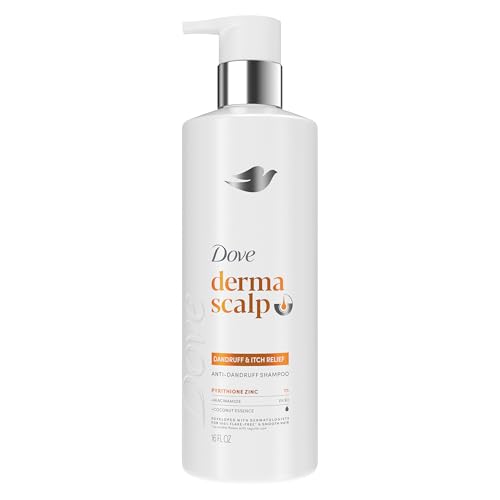
Dove Derma Scalp Dandruff & Itch Relief Shampoo with Pyrithione Zinc (16 fl oz)
Pyrithione Zinc Anti-Dandruff Shampoo
Best for: Budget buyers with mild dandruff itch who wash often and like a conditioning feel
- Active
- Pyrithione zinc
- Labeled for
- Dandruff and itch relief
- Size
- 16 fl oz
- Feel
- Moisturizing, conditioning
Dove's Derma Scalp Dandruff & Itch Relief Shampoo brings pyrithione zinc to Dove's familiar, conditioning shampoo style. For people with mild dandruff who find medicated shampoos leave their hair rough, it is a comfortable everyday option, and the 16-ounce bottle gives it the lowest cost per ounce among our medicated picks.
It does the basic job well: pyrithione zinc targets the yeast behind dandruff, and regular use controls mild flaking and the itch that comes with it. Buyers often mention that hair feels softer than with typical anti-dandruff shampoos, which matters if you wash frequently.
Skip it if your itch might be allergic. This is a scented, mass-market formula, and fragrance is one of the most common triggers for contact dermatitis on the scalp. People with stubborn flaking or psoriasis will also need a stronger or different active.
What We Liked
- Lowest cost per ounce among medicated picks
- Pyrithione zinc for mild dandruff and itch
- Softer, more conditioning feel than many medicated shampoos
What We Didn't
- Scented, so not for allergy-prone scalps
- Mild strength for stubborn flaking
- No help for psoriasis plaques
The Bottom Line
A comfortable, cheap way to control mild dandruff itch, as long as fragrance is not your trigger.
Contact Allergy: When Your Products Are the Problem
Hair products are a common, underrecognized cause of scalp itch. Fragrance is the most frequent culprit across cosmetics, and that includes essential oils like tea tree, lavender and peppermint, which are marketed as soothing but are known sensitizers. Tea tree oil is a particular trap for itchy-scalp sufferers, because it is everywhere in scalp products and becomes more allergenic as it oxidizes in an open bottle.
Surfactants and preservatives can also trigger reactions. Cocamidopropyl betaine and alkyl glucosides, both common in gentle and sulfate-free shampoos, have each been named Allergen of the Year by the American Contact Dermatitis Society. Preservatives such as methylisothiazolinone have caused waves of reactions in rinse-off and leave-on products. Most people tolerate these ingredients well; the point is that a gentle or natural label is no guarantee.
Tea tree oil is a particular trap for itchy-scalp sufferers
Hair dye deserves its own warning. Paraphenylenediamine, or PPD, found in many permanent dyes, is a potent allergen, and reactions can range from itching and redness to severe swelling of the scalp, face and eyelids. Severe swelling after coloring needs urgent medical attention. If you color your hair, a patch test before each application, as dye packaging instructs, is worth the inconvenience.
The practical test is an elimination trial. Switch every product that touches your scalp, including shampoo, conditioner and styling products, to the plainest fragrance-free options you can find for three to four weeks. If the itch fades, reintroduce products one at a time. If it persists or you need a definite answer, a dermatologist can perform patch testing to identify the exact allergen.
Scalp Psoriasis and Thick Scale
Psoriasis is an immune-driven condition in which skin cells turn over far faster than normal, building up thick, silvery plaques. The scalp is one of the most common places for it to appear, and for many people it is the most frustrating, because hair makes it harder to treat and plaques are visible along the hairline. Itch can be intense, and scratching or picking at scale can worsen plaques.
Over-the-counter shampoos help most for mild scalp psoriasis. A salicylic acid shampoo lifts and softens scale, and a coal tar shampoo reduces the plaques and itch. Leave each on for several minutes before rinsing. Coal tar has practical downsides: it smells, can stain light or gray hair, and makes skin more sensitive to the sun for a time after use. It is a long-standing FDA-recognized treatment, but people needing it long term should discuss it with a dermatologist.
Never pick or scrape plaques
Heavy, stuck-on scale sometimes needs softening before shampoo can work. Applying an oil or a scale-softening product, leaving it on for a period, and then washing with a medicated shampoo can help. Never pick or scrape plaques, which can cause bleeding and, through a process called the Koebner response, trigger new psoriasis in injured skin.
Moderate to severe scalp psoriasis, plaques that bleed or spread, or psoriasis with joint pain needs a dermatologist. Prescription topical steroids, vitamin D analogues and systemic treatments are far more effective than shampoo alone. Scalp psoriasis can cause temporary hair shedding where plaques are thick, though hair usually regrows once inflammation is controlled.
Dry Scalp vs. Dandruff: Why the Difference Matters
Dry scalp and dandruff both produce flakes and itch, so they are easy to confuse, but they need opposite approaches. Dry scalp is a lack of moisture in the skin, usually from cold, dry air, hot showers, harsh shampoos or over-clarifying. Dandruff is driven by yeast and an inflammatory response to the oils the scalp produces. Treating one as the other often makes things worse.
The flakes are the best clue. Dry scalp flakes are small, white and powdery, fall easily, and usually come without redness or greasiness; the skin may feel tight, and you may also have dry skin on your arms and legs. Dandruff flakes are larger, may be yellowish or oily, often cling to the scalp and hair, and the scalp may look red or feel greasy.
Dry scalp and dandruff both produce flakes and itch, so they are easy to confuse, but they need opposite approaches.
If it is dry scalp, cut back on harsh and heavily scented shampoos, wash with lukewarm water, condition, and consider a humidifier in winter. A fragrance-free gentle shampoo is often all you need. Medicated anti-dandruff shampoos are not necessary, and strong ones like selenium sulfide can feel drying.
If it is dandruff, moisturizing alone will not clear it, and heavy oils applied to the scalp can sometimes feed the yeast. Use an anti-dandruff shampoo two or three times a week. If you cannot tell which you have, a gentle pyrithione zinc shampoo like CeraVe's is a reasonable middle ground, because it treats dandruff without being harsh on a dry scalp.
| Dry scalp | Dandruff | |
|---|---|---|
| Flakes | Small, white, powdery | Larger, yellowish or oily |
| Scalp feel | Tight, dry | Often greasy |
| Redness | Little or none | Common |
| Main trigger | Dry air, hot water, harsh products | Yeast plus scalp oil |
| Best shampoo | Gentle, fragrance-free | Anti-dandruff active |
When an Itchy Scalp Needs a Dermatologist
Most itchy scalps improve with the right over-the-counter shampoo within a few weeks. If you have used a well-matched product consistently for about four weeks with no improvement, it is time to see a dermatologist rather than cycling through more bottles. Persistent seborrheic dermatitis and psoriasis respond well to prescription treatments that shampoos cannot match.
Itch combined with hair loss deserves prompt attention. Scarring alopecias such as lichen planopilaris and frontal fibrosing alopecia can begin with itching, burning or tenderness, redness or scale around follicles, and gradual hair loss. Hair lost to scarring conditions does not regrow, so early diagnosis matters. Seek care if you notice shiny, smooth patches, a receding hairline with redness, or loss of eyebrows alongside scalp symptoms.
Itch combined with hair loss deserves prompt attention.
Other red flags include painful or pus-filled bumps, which can mean folliculitis or infection; scaly patches with broken hairs in a child, which can mean a fungal scalp infection that needs oral treatment; visible lice or nits; open sores or bleeding; and plaques spreading well beyond the hairline. Severe swelling of the scalp, face or eyelids after hair dye needs urgent care.
Finally, if you are using hair loss treatments such as minoxidil and your scalp has started itching, the cause may be the product's vehicle, often propylene glycol in liquid formulas, rather than a new scalp condition. Switching to a foam formula frequently helps. Our minoxidil guides explain the options, and a dermatologist can help if irritation continues.
Compared Side by Side
| Product | Active | Main Cause Treated | Fragrance | Best For |
|---|---|---|---|---|
| CeraVe Hydrating Anti-Dandruff | Pyrithione zinc | Dandruff, seb derm | Check label | Best overall |
| Vanicream Shampoo | None | Product allergy, sensitivity | Fragrance-free | Allergy-prone scalps |
| Head & Shoulders BARE | 1% pyrithione zinc | Dandruff | Check label | Sulfate-free medicated |
| MG217 Coal Tar | 0.5% coal tar | Psoriasis, seb derm | Medicated odor | Scalp psoriasis |
| Nizoral Psoriasis | Salicylic acid | Psoriasis scale | Contains tea tree oil | Thick scale |
| Dove Derma Scalp | Pyrithione zinc | Mild dandruff | Scented | Best value |
Ready to Buy? Our Picks Again
- 1Check Price →
- 2Check Price →
Best for Sensitive & Allergy-Prone Scalp
Vanicream Shampoo for Sensitive Skin (12 fl oz) - 3Check Price →
Best Sulfate-Free Dandruff Pick
Head & Shoulders BARE Soothing Hydration Anti-Dandruff Shampoo, 1% Pyrithione Zinc (13.5 fl oz) - 4Check Price →
Best for Scalp Psoriasis
MG217 Psoriasis Shampoo and Conditioner with 0.5% Coal Tar (8 fl oz) - 5Check Price →
Best for Thick Scale
Nizoral Psoriasis Shampoo & Conditioner with Salicylic Acid and Tea Tree Oil (11 oz) - 6Check Price →
Common Mistakes to Avoid
Choosing a Tingly Tea Tree Shampoo for Itch
Cooling, tingly shampoos with tea tree, peppermint or menthol feel soothing for a moment, but essential oils are common allergens and irritants. If your itch is allergic, they can make it worse. Use a plain, fragrance-free shampoo until you know the cause, and save the tingle for a healthy scalp.
Moisturizing Away Dandruff
Rich oils and moisturizing shampoos will not clear dandruff or seborrheic dermatitis, which are driven by yeast and inflammation, and some oils on the scalp can make flaking worse. If your flakes are larger, greasy or come with redness, use an anti-dandruff active such as pyrithione zinc, selenium sulfide or ketoconazole.
Rinsing Medicated Shampoo Straight Out
Anti-dandruff and psoriasis shampoos need contact time to work. Lathering and rinsing immediately wastes most of the active ingredient. Massage it into the scalp, leave it on for the few minutes the label recommends, then rinse thoroughly. That one change makes many people's shampoo noticeably more effective.
Ignoring Itch That Comes With Hair Loss
Itching or burning with patchy loss, redness around follicles or a receding hairline can signal a scarring alopecia, where lost hair does not grow back. Do not spend months switching shampoos. See a dermatologist promptly, because early treatment is what protects the follicles that remain.
Skipping the Patch Test Before Hair Dye
Hair dye allergies, especially to PPD, can develop after years of uneventful coloring and range from itch to severe facial swelling. Do the patch test the packaging instructs before every application. If your scalp itches or swells after coloring, stop using that dye and seek care for any significant swelling.
Frequently Asked Questions
What is the best shampoo for itchy scalp?
For most people, CeraVe Hydrating Anti-Dandruff Shampoo is the best shampoo for itchy scalp, because dandruff and seborrheic dermatitis are the most common causes and it pairs pyrithione zinc with a gentle base. If products may be causing your itch, Vanicream is better. For psoriasis, try MG217 coal tar.
Why is my scalp so itchy but I don't have dandruff?
Itch without flakes often comes from a reaction to a product, such as fragrance, a preservative or hair dye, or from dry, irritated skin caused by hot water and harsh shampoos. Less commonly it is lice, folliculitis or an early scalp condition. Try three to four weeks of plain, fragrance-free products, and see a doctor if it persists.
Is dry scalp the same as dandruff?
No. Dry scalp produces small, white, powdery flakes with a tight feel and little redness, and responds to gentle, moisturizing care. Dandruff produces larger, often yellowish or oily flakes, sometimes with redness, and is driven by yeast. It needs an anti-dandruff active like pyrithione zinc, selenium sulfide or ketoconazole.
Can an itchy scalp cause hair loss?
The itch itself rarely causes hair loss, but heavy scratching can break hairs, and inflammatory conditions such as seborrheic dermatitis and psoriasis can increase shedding until they are controlled. Itch or burning with patchy loss can signal a scarring alopecia, which needs prompt dermatologist care because lost hair in those conditions does not regrow.
Is tea tree oil good for an itchy scalp?
Sometimes, but with a real caveat. A small study found a 5% tea tree oil shampoo helped mild dandruff. However, tea tree oil is a known cause of allergic contact dermatitis, especially once it oxidizes. If your itch could be allergic, or your scalp is sensitive, avoid it and use a fragrance-free shampoo instead.
How often should I use a medicated shampoo for itchy scalp?
Follow the label, but most anti-dandruff and psoriasis shampoos are used two or three times a week at first, left on for a few minutes before rinsing. Once symptoms settle, many people drop to once or twice a week for maintenance and use a gentle shampoo on other days.
When should I see a dermatologist for an itchy scalp?
See a dermatologist if four weeks of a well-matched shampoo has not helped, or right away if itch comes with hair loss, pain, pus-filled bumps, open sores, thick spreading plaques, or scaly patches with broken hairs in a child. Severe swelling after hair dye needs urgent medical care.
The Bottom Line
An itchy scalp is a symptom, so match the shampoo to the cause. CeraVe Hydrating Anti-Dandruff is the best starting point because dandruff is the most common culprit. Choose Vanicream if your products may be to blame, MG217 coal tar for psoriasis and Nizoral Psoriasis for thick scale. If four weeks brings no relief, or itch comes with hair loss, see a dermatologist.
More Buyer's Guides
Hair Growth & Hair Loss
Best Ketoconazole Shampoo
Ketoconazole is a proven dandruff fighter with a small but intriguing body of evidence for hair loss. Over the counter, one brand dominates, so the smarter questions are which size to buy, how to use it, and what to rotate it with.
Hair Care
Best Shampoo for Oily Hair
Oily hair is mostly down to hormones and genetics, not something you did wrong. The right daily shampoo removes sebum efficiently without leaving your scalp tight or your ends dry, and washing more often will not make it worse.
Hair Care
Best Sulfate-Free Shampoo
Sulfates are not toxic and they do not cause hair loss, but they are strong cleansers that can leave dry, curly, bleached or sensitive hair rougher than it needs to be. These are the gentler everyday shampoos worth switching to, and who can safely skip the trend.
Hair Care
Best Scalp Scrub
A good scalp scrub clears product buildup, excess oil and dead skin that shampoo leaves behind. It will not regrow hair, and the wrong one can irritate. These are the physical and chemical scalp exfoliants worth using, and who should skip them.
Hair Care
Best Shampoo for Color-Treated Hair
Every wash takes a little color with it. The right shampoo slows that down by cleaning gently and leaving the cuticle smooth, but how you wash matters as much as what you wash with. These are the color-protecting shampoos worth buying, and the routine that makes them work.
Hair Growth & Hair Loss
Best Minoxidil for Men
Every product here contains 5% minoxidil, the only topical hair regrowth drug the FDA has approved for men. What separates them is the vehicle, the irritation risk, and what you pay per month for the next decade.