Our Picks at a Glance
- 1
 Check Price →
 - 2
 Check Price →
 - 3
 Check Price →
 - 4
 Check Price →
Best for Long or Thick Hair
REVLON SmoothStay XL Heated Straightening Brush - 5
 Check Price →
Best Premium
CHI Lava Heated Straightening Brush - 6
 Check Price →
Best for Coarse Hair
BaBylissPRO Nano Titanium Thermal Paddle Brush (BNTPB1UC) - 7
 Check Price →
Best Hot Comb for Roots
INFINITIPRO by Conair Gold-Plated Straightening Comb
The Short Version
- The TYMO Ring is the best overall straightening brush, with five temperature settings and anti-scald bristle tips according to its listing.
- The L'ANGE Le Vite is the best travel pick thanks to dual voltage, and the Conair Diamond-Infused brush is the best budget option.
- A straightening brush smooths and softens; it does not match a flat iron's sleekness. Expect a natural, polished result rather than poker-straight hair.
- Use it only on fully dry hair, always with a heat protectant, and at the lowest setting that works, especially if your hair is fine, thinning or chemically treated.
- Heat does not cause pattern hair loss, but repeated high heat causes breakage that can make thin hair look thinner.
On This Page · 12 sections
The best hair straightening brush is a heated brush that smooths and relaxes dry hair as you brush through it, with heat settings low enough to protect fine or fragile hair and bristle tips that keep the hot surface off your scalp. It is a halfway house between a regular brush and a flat iron: faster and more forgiving than a straightener, with a softer, more natural finish, but not able to produce the pin-straight, mirror-shine look that clamping plates can.
It is worth being clear about what this tool is, because three similar-sounding products get confused. A straightening brush is used on dry hair and has heated bristles or a heated plate but no airflow. A hair dryer brush, which we cover in our guide to the best hair dryer brush, blows hot air and is used on damp hair to dry and style at the same time. A flat iron clamps hair between two hot plates for the sleekest result; see the best flat iron for those. If you want to dry and smooth in one step, you want a dryer brush; if your hair is already dry and you want it smoother, you want a straightening brush.
We ranked the brushes on what decides both results and hair health: the range and control of heat settings, especially low settings for fine or thinning hair; how well the bristle design protects the scalp; how evenly the brush heats; safety features like auto shut-off; ease of use on different lengths and textures; and the consistency of verified buyer feedback. This is a research-based ranking rather than a hands-on test, and every pick links to its exact Amazon listing by ASIN.
Straightening Brush vs. Flat Iron vs. Hot-Air Brush
A straightening brush looks like a paddle or ring brush, but its bristles or base plate are heated. You brush it slowly through dry hair in sections, and the combination of gentle tension and heat relaxes the hair's shape, smoothing frizz and loosening waves. The result is softer and more natural than a flat iron, with some body left in, and it takes less skill to get right.
A flat iron clamps a section of hair between two hot plates and pulls it straight. That gives the sleekest, flattest finish and is the only one of the three that produces poker-straight hair on wavy or curly textures. It also concentrates heat and pressure on the hair more than a brush, which is why technique and temperature control matter so much with irons.
A hot-air brush, or hair dryer brush, is a different tool: it blows heated air and is used on damp hair to dry and style at once, much like a round-brush blowout. You cannot use a straightening brush on damp hair, and a hot-air brush is not designed to restyle already-dry hair. Many people own one of each for different days.
If your aim is smooth, frizz-free hair with minimal effort and you are happy with a natural finish, a straightening brush is the gentlest route. If you need sleek, glass-like straightness, a flat iron is the better tool. If you want to cut drying and styling into one step after washing, choose a hair dryer brush.
| Straightening Brush | Flat Iron | Hot-Air Brush | |
|---|---|---|---|
| Hair state | Dry | Dry | Damp |
| How it works | Heated bristles or plate | Clamping hot plates | Heated airflow |
| Finish | Smooth, natural | Sleek, very straight | Smooth with volume |
| Skill needed | Low | Moderate | Low |
| Heat stress | Lower | Higher | Moderate |
Heat, Breakage and Thinning Hair: What a Hot Brush Can and Cannot Do
Heat styling does not cause pattern hair loss. Androgenetic alopecia, the common cause of thinning in men and women, is driven by genetics and hormones at the follicle, and no styling tool reaches that deep. What heat can do is damage the hair shaft that has already grown, and that damage matters more when your hair is fine or thinning.
Hair is made mostly of keratin protected by an outer cuticle layer. Repeated high heat lifts and cracks the cuticle and weakens the proteins inside, leaving hair dry, brittle and prone to snapping. Each broken strand is shorter than it should be, so over months, heavy heat use can make hair look thinner, especially at the ends and around the face, even though the follicles are fine.
Heat styling does not cause pattern hair loss.
For people with fine, thinning or chemically treated hair, that breakage is the main risk to manage. Thinner strands have less mass to absorb heat and break more easily, and when you have less hair to start with, every broken strand is more visible. This is where a straightening brush has an advantage: it typically uses less clamping pressure than an iron, and you can get a smoother look at a lower setting.
A hot brush will not thicken hair, regrow it, or repair split ends. If you are noticing more scalp showing through, the cause is usually at the follicle rather than in your styling. Treatments with evidence, such as minoxidil, target that; our guide to the best shampoo for thinning hair and our hair growth product roundups cover the options.
The 7 Best Hair Straightening Brushes
The brushes below are ranked on heat control, scalp protection, even heating, ease of use and buyer feedback. Every one is used on dry hair. If your hair is fine, thinning or chemically treated, favor the picks with clearly listed low settings and always start at the lowest temperature.
TYMO Ring Hair Straightener Brush, 2-in-1 Straightening Brush & Hot Comb
Heated Straightening Brush
Best for: Most people with straight, wavy or loosely curly hair who want quick, smoother styling
- Heat settings
- 5 (per listing)
- Heat-up
- About 20 seconds (per listing)
- Scalp protection
- Anti-scald bristle tips
- Use on
- Dry hair only
TYMO's Ring is one of the most popular straightening brushes on Amazon, and it earns its place at the top by getting the important details right. According to the listing, it heats up in around 20 seconds, offers five temperature settings, and has anti-scald tips on its bristles, so the hot surface does not press directly into the scalp. The five settings matter most: they let you start low on fine or fragile hair and only go higher if you need to.
Buyer feedback consistently describes a smoother, frizz-reduced finish in a few passes on straight to wavy hair, with a softer and more natural look than a flat iron. The comb-like bristle layout works for medium and longer lengths and makes it easy to work from roots to ends in sections.
Skip it if you want truly sleek, pin-straight results or have very tightly coiled hair; a flat iron or a hot comb gives more control there. Like every heated brush, it works only on dry hair and should be used with a heat protectant. If your hair is fine or thinning, stay on the lower settings.
What We Liked
- Five heat settings with low options for fine hair
- Anti-scald bristle tips protect the scalp
- Quick heat-up and simple to use
- Natural, smoother finish in a few passes
What We Didn't
- Not as sleek as a flat iron
- Less effective on tightly coiled hair
- Several similar TYMO models, so check the listing
The Bottom Line
The best straightening brush for most people: easy, adjustable and gentle enough for everyday touch-ups.
L'ANGE HAIR Le Vite Straightening Brush, Dual-Voltage Ceramic Hot Brush
Heated Straightening Brush
Best for: People who travel internationally and want one smoothing tool that works abroad
- Surface
- Ceramic
- Voltage
- Dual voltage (per listing)
- Size
- Standard
- Use on
- Dry hair only
L'ANGE's Le Vite is a well-established ceramic straightening brush, and its standout feature is dual voltage. According to the listing, it can be used in countries with different mains voltages, which most hair tools cannot do safely without a converter. If you travel and want a single smoothing tool that works both at home and abroad, that alone makes it the pick. You may still need a plug adapter.
Beyond travel, it is a capable everyday brush. Ceramic surfaces tend to spread heat evenly, which helps avoid hot spots, and buyer feedback is positive about its smoothing and frizz control on straight to wavy hair. It also comes in several finishes, which some buyers care about.
Check the listing for the exact temperature range and settings before buying if you have fine or thinning hair, and start at the lowest available setting. Skip it if you never travel; the TYMO Ring offers similar performance with clearly listed temperature options.
What We Liked
- Dual voltage for international travel
- Ceramic surface for even heat
- Positive feedback on smoothing and frizz
What We Didn't
- Check the listing for exact temperature settings
- May still need a plug adapter abroad
- Little advantage over the TYMO for non-travelers
The Bottom Line
The straightening brush to pack for international trips, and a solid everyday brush too.
Conair Diamond-Infused Ceramic Smoothing Hot Brush/Straightening Brush, 3 Heat Settings
Heated Straightening Brush
Best for: First-time buyers who want to try a straightening brush without spending much
- Heat settings
- 3 (per listing)
- Maximum heat
- 400°F (per listing)
- Surface
- Diamond-infused ceramic
- Use on
- Dry hair only
Conair is one of the most established names in affordable hair tools, and its Diamond-Infused Ceramic Hot Brush is a simple, low-cost way to try straightening-brush styling. According to the listing, it has three heat settings with a maximum of 400°F and a ceramic surface. That is a reasonable range for most hair types, and the low setting is the one to use on fine or thinning hair.
It typically costs less than the TYMO and L'ANGE brushes, and buyer feedback describes good smoothing for the price on straight and wavy hair. It is a sensible choice if you are not sure a straightening brush will suit you, or if you want a basic tool for second-day touch-ups.
The trade-offs are fewer heat steps and less refined bristle design than the top picks, so fine-tuning the temperature is harder. Do not default to the high setting; 400°F is more than most people need, and fine or damaged hair should stay at the lowest setting. Skip it if you want precise temperature control.
What We Liked
- Low cost from an established brand
- Three heat settings including a lower option
- Ceramic surface for even heat
What We Didn't
- Only three heat steps
- Top setting is too hot for fine or damaged hair
- Less refined than the TYMO or L'ANGE
The Bottom Line
The best budget straightening brush. Use the lowest setting that works and it is a capable starter tool.
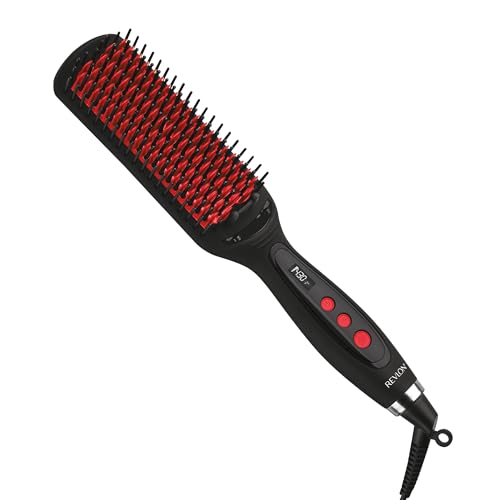
REVLON SmoothStay XL Heated Straightening Brush
Heated Straightening Brush
Best for: People with long or thick hair who want to cover more hair per pass
- Size
- XL brush head
- Brand
- Revlon SmoothStay line
- Use on
- Dry hair only
- Settings
- Check listing
Revlon's SmoothStay XL is a larger straightening brush, and the extra size is the point. A bigger brush head covers more hair with each stroke, which can noticeably cut styling time on long or thick hair, where small brushes need many more sections. Revlon is a dependable mass-market tool brand with broad retail availability.
For people with long hair, fewer passes is not just about speed. Every pass is another dose of heat, so covering more hair per stroke can mean less total heat exposure for the same result. Buyer feedback on larger straightening brushes generally reflects that, praising faster styling on long hair.
A bigger head is harder to maneuver near the roots and on shorter cuts, and it is not the right size for a bob or short hair. Check the listing for its exact temperature settings and start low. Skip it if your hair is short or fine; the TYMO Ring is easier to control.
What We Liked
- XL head covers more hair per pass
- Fewer passes can mean less total heat on long hair
- Established mass-market brand
What We Didn't
- Awkward on short hair and near the roots
- Check the listing for heat settings
The Bottom Line
A smart pick for long or thick hair where a bigger brush saves both time and heat.
CHI Lava Heated Straightening Brush
Heated Straightening Brush
Best for: People who already like CHI tools and want a premium heated brush
- Brand
- CHI Lava line
- Price tier
- Premium
- Use on
- Dry hair only
- Settings
- Check listing
CHI is a well-known salon and consumer hair tool brand, best known for its ceramic flat irons, and the Lava Heated Straightening Brush brings its Lava line to the heated brush category. It is the premium pick here, typically costing about twice as much as the TYMO Ring.
The appeal is the brand's track record with ceramic heat tools and build quality. If you already use and trust a CHI flat iron, the Lava brush is a natural companion for quick smoothing on days when you do not want to clamp your hair. Buyer feedback on this newer model is more limited than on the long-running TYMO and L'ANGE brushes, so weigh that.
Check the listing for its temperature settings before buying, and start low on fine or thinning hair. Skip it if value matters; nothing in the straightening brush category suggests that paying double guarantees a healthier or smoother result, and the TYMO delivers well for less.
What We Liked
- Premium brand with a strong heat-tool reputation
- A natural companion to CHI flat irons
- Positioned as a higher-build-quality option
What We Didn't
- About twice the price of the TYMO Ring
- Less long-term buyer feedback than older models
- Check the listing for heat settings
The Bottom Line
A premium heated brush for CHI loyalists; most buyers will do just as well with the TYMO.
BaBylissPRO Nano Titanium Thermal Paddle Brush (BNTPB1UC)
Thermal Paddle Brush
Best for: People with thick or coarse hair who want a salon-brand thermal paddle
- Surface
- Nano titanium
- Shape
- Paddle
- Use on
- Dry hair only
- Settings
- Check listing
BaBylissPRO is a professional salon brand best known for its Nano Titanium flat irons, and this thermal paddle brush applies the same titanium approach to a heated paddle. Titanium heats quickly and holds high heat well, which is why stylists often prefer it for thick and coarse hair that resists smoothing at lower temperatures.
The wide paddle shape covers a lot of hair per pass and makes it easy to smooth long lengths. For people with dense or coarse hair who find gentler brushes do not do much, this is the stronger option. It is priced in the upper-middle range, below the CHI Lava.
That strength is also the warning. Titanium tools transfer heat efficiently, and they are easy to overuse on fine, thinning or damaged hair. Skip it if your hair is fine or fragile; a ceramic brush with low settings, like the TYMO, is the safer choice. Check the listing for the exact temperature controls before buying.
What We Liked
- Titanium heats quickly and holds heat for coarse hair
- Wide paddle covers long hair efficiently
- Professional salon brand
What We Didn't
- Easy to overuse on fine or thinning hair
- Check the listing for temperature controls
- Overkill for straight or fine hair
The Bottom Line
A strong thermal paddle for thick, coarse hair. Not the one to choose if your hair is fine or fragile.
INFINITIPRO by Conair Gold-Plated Straightening Comb
Heated Straightening Comb
Best for: Smoothing roots and edges on textured or coily hair
- Type
- Heated straightening comb
- Plating
- Gold-plated
- Heat
- Ultra-high heat (per listing)
- Use on
- Dry hair only
Hot combs, sometimes called pressing combs, have long been used to smooth tightly curled and coily hair, especially at the roots, where flat irons and brushes struggle to get close without catching the scalp. Conair's InfinitiPRO straightening comb is a simple, low-cost electric version with gold-plated teeth, and it is useful for touching up new growth, edges and the hairline between fuller styling sessions.
Its narrow teeth reach close to the root in a way a paddle or ring brush cannot, and it is the most affordable tool on this list. For textured hair that a straightening brush barely changes, it can give a much smoother result.
The listing describes it as ultra-high heat, and that deserves respect. Use it on fully dry hair with heat protectant, keep sessions short, and keep it well clear of the scalp, forehead and ears, since hot combs can burn skin quickly. Skip it for fine or straight hair, where a straightening brush is gentler, and avoid daily use.
What We Liked
- Reaches roots and edges that brushes cannot
- Very effective on coily and tightly curled hair
- Lowest price on this list
What We Didn't
- High heat with real burn risk near the scalp
- Too intense for fine or straight hair
- Not suited to daily use
The Bottom Line
A useful root and edge tool for textured hair, used sparingly and with care.
What Temperature Should You Use?
The right temperature is the lowest one that smooths your hair in one or two passes. Higher heat works faster, but the damage it causes builds up wash after wash. Most straightening brushes offer several settings, and the safest approach is to start at the bottom and move up one step at a time only if your hair is not responding.
As a general guide used by stylists, fine, thinning, damaged or color-treated hair usually responds well at lower settings, often around 300°F or a little above. Medium, healthy hair typically needs a middle setting. Thick, coarse or very curly hair may need higher heat, but going toward the top of the range should be the exception, not a default. Exact numbers vary by tool, so check your brush's manual.
The right temperature is the lowest one that smooths your hair in one or two passes.
Watch for signs that it is too hot: steam or sizzling when you brush through, which means the hair was not fully dry; a burnt smell; or hair that feels rough and straw-like afterward. Any of those is a signal to turn the heat down and check that your hair is completely dry.
Fewer passes at a sensible temperature are always better than many passes at high heat. Work in small sections, move slowly enough that the heat can do its job, and avoid going over the same section repeatedly. A good heat protectant applied beforehand helps reduce the damage of the heat you do use.
How to Use a Straightening Brush for Smooth Results
Start with clean, completely dry hair. Using a heated brush on damp hair boils the water inside the strand, which is one of the fastest ways to cause damage. If you have just washed, blow-dry first on a moderate heat, or let it air dry. Apply a heat protectant spray evenly and let it dry before you turn the brush on.
Detangle with a regular brush first so the heated brush can glide. Divide your hair into sections, clipping the top layers out of the way. Thick hair needs more, smaller sections; fine hair can use fewer, larger ones. Starting at the underside of the hair near the nape is easiest.
Place the brush under a section near the root, keeping the bristle tips against the scalp rather than the hot base, and pull slowly down to the ends with gentle tension. For more smoothness, hold the ends taut with your free hand or with the tips of a comb. One or two slow passes are better than several fast ones.
Let each section cool before touching it, since hair sets as it cools. Finish with a light serum or oil on the ends if your hair is dry, and unplug the brush and let it cool on a heat-resistant surface. The whole process usually takes less time than a flat iron, which is part of the appeal.
Ionic, Ceramic and Titanium Claims, Honestly
Straightening brush listings are full of materials and technology terms. Some describe real differences; others are marketing. Ceramic is the most common surface. It tends to heat evenly and is generally considered gentle, which makes it a good default for most hair, including fine hair. Diamond-infused or tourmaline-coated ceramic is a variation; claims of extra smoothness are mostly marketing, and the underlying ceramic is what matters.
Titanium heats faster and transfers heat more efficiently than ceramic. That can be useful for thick or coarse hair that needs more heat to smooth, but it also makes it easier to overdo it on fine or damaged hair. If your hair is fragile, a titanium brush is not the obvious choice, however professional it looks.
Treat ionic as a pleasant extra rather than a reason to choose one brush over another.
Ionic features claim to emit negative ions that reduce static and frizz. There is a plausible basis for reduced static, and many users like the result, but the evidence that ionic features in a heated brush make a meaningful difference to hair health is limited. Treat ionic as a pleasant extra rather than a reason to choose one brush over another.
The features with clearer value are practical ones: a good range of heat settings with real low options, anti-scald bristle tips, auto shut-off, a swivel cord and a cool-touch handle. Those protect your hair and your scalp, and they matter more than any coating.
Scalp Burns, Safety and Who Should Skip It
Heated brushes and combs get close to the scalp by design, which makes burns a real risk. Look for bristles with protective tips, keep the heated base angled away from the skin, and take extra care around the hairline, ears and neck. Hot combs need the most caution, since their teeth sit close to the skin at the root.
Hot combs were historically linked to a form of scarring hair loss at the crown seen mainly in women of African descent, now called central centrifugal cicatricial alopecia. Researchers now think its causes are more complex and include genetics, but dermatologists still advise limiting heat, tension and harsh chemical processes for anyone with that risk. If you notice tenderness, itching or a thinning patch at the crown, see a dermatologist early, since scarring hair loss is easier to slow than reverse.
Choose a brush with auto shut-off, never leave it on unattended, and keep it away from water. Let it cool fully before storing, and keep it out of reach of children and pets.
Skip heated styling altogether, or keep it to the lowest settings and occasional use, if your scalp is sunburned, inflamed or broken, if you are using a treatment that irritates the scalp, or if your hair is breaking badly. Give it a rest, focus on gentle care and conditioning, and bring heat back slowly once the hair feels stronger.
Compared Side by Side
| Product | Type | Heat Control | Standout Feature | Best For |
|---|---|---|---|---|
| TYMO Ring | Straightening brush | 5 settings | Anti-scald tips | Best overall |
| L'ANGE Le Vite | Straightening brush | Check listing | Dual voltage | Travel |
| Conair Diamond-Infused | Straightening brush | 3 settings | Low price | Budget |
| Revlon SmoothStay XL | Straightening brush | Check listing | XL head | Long or thick hair |
| CHI Lava | Straightening brush | Check listing | Premium build | CHI fans |
| BaBylissPRO Thermal Paddle | Thermal paddle | Check listing | Titanium | Coarse hair |
| InfinitiPRO Straightening Comb | Hot comb | High heat | Reaches roots | Textured roots |
Ready to Buy? Our Picks Again
- 1Check Price →
- 2Check Price →
- 3Check Price →
- 4Check Price →
Best for Long or Thick Hair
REVLON SmoothStay XL Heated Straightening Brush - 5Check Price →
Best Premium
CHI Lava Heated Straightening Brush - 6Check Price →
Best for Coarse Hair
BaBylissPRO Nano Titanium Thermal Paddle Brush (BNTPB1UC) - 7Check Price →
Best Hot Comb for Roots
INFINITIPRO by Conair Gold-Plated Straightening Comb
Common Mistakes to Avoid
Using It on Damp Hair
A straightening brush is designed for dry hair. Brushing damp hair with a hot tool turns the water inside the strand to steam, which can blister and crack the cuticle. If you hear sizzling or see steam, stop. Blow-dry or air-dry first, or use a hair dryer brush if you want to style damp hair.
Defaulting to the Highest Setting
High heat works faster, but the damage builds up with every use. Fine, thinning, damaged or color-treated hair rarely needs the top setting. Start at the lowest temperature, move up one step only if your hair does not smooth, and never use more heat than you need.
Skipping Heat Protectant
A heat protectant spray will not make heat harmless, but it reduces the damage each session causes. Apply it evenly to dry hair, let it dry fully, then style. If your hair is fine or thinning, choose a lightweight formula that will not weigh it down.
Making Too Many Passes
Brushing the same section over and over adds heat without adding much smoothness. Work in smaller sections, move slowly enough for the heat to work, and stop after one or two passes. Many passes at moderate heat can do as much damage as one pass at high heat.
Expecting Flat Iron Results
A straightening brush gives a smooth, natural finish with some body. It will not produce poker-straight, glossy hair, especially on curly textures. Turning the heat up to chase that look is how damage happens. If you need sleek straightness, use a flat iron carefully instead.
Frequently Asked Questions
What is the best hair straightening brush?
For most people, the TYMO Ring is the best hair straightening brush thanks to its five heat settings, quick heat-up and anti-scald bristle tips. The L'ANGE Le Vite is best for travel because it is dual voltage, and the Conair Diamond-Infused Ceramic brush is the best budget option.
Is a straightening brush better for your hair than a flat iron?
It can be gentler. Straightening brushes typically use less clamping pressure than flat irons, and many people get a smooth result at a lower setting. The difference depends on temperature and how many passes you make. Used at high heat with repeated passes, any heated tool can damage hair.
Can you use a straightening brush on wet hair?
No. Straightening brushes are designed for completely dry hair. Using one on wet or damp hair heats the water inside the strand and can cause serious damage. If you want to style damp hair, use a hair dryer brush, which blows hot air, or blow-dry first.
Do straightening brushes work on curly hair?
They soften and smooth waves and loose curls well, but they rarely make tightly curled or coily hair fully straight. For textured hair, many people blow-dry first, then use a straightening brush for smoothing, and a hot comb or flat iron for roots or sleeker results.
Is a straightening brush safe for thinning hair?
Used carefully, yes. Choose a brush with low heat settings, use the lowest temperature that works, apply heat protectant and limit passes. Heat does not cause pattern hair loss, but breakage makes thin hair look thinner, so keep heat styling occasional rather than daily if you can.
What temperature should I use on a straightening brush?
Start at the lowest setting and increase only if needed. Fine, thinning or damaged hair usually responds at lower settings, often around 300°F, while thick or coarse hair may need more. Exact settings vary by tool, so check the manual, and turn it down if you notice steam or a burnt smell.
What is the difference between a straightening brush and a hot air brush?
A straightening brush has heated bristles or a heated plate and is used on dry hair to smooth it. A hot air brush, or hair dryer brush, blows heated air and is used on damp hair to dry and style it at the same time. They solve different problems.
The Bottom Line
A heated straightening brush is one of the gentler ways to smooth dry hair, as long as you keep the temperature low. The TYMO Ring is the best overall, the L'ANGE Le Vite is the travel pick, and the Conair Diamond-Infused brush is the budget choice. Always start with dry hair, heat protectant and the lowest setting that works.
More Buyer's Guides
Hair Tools
Best Flat Iron
A flat iron presses hot plates directly onto your hair, which makes it the most damaging tool most people own. The right one gets you straight in a single pass at the lowest temperature that works. We ranked seven on exactly that.
Hair Tools
Best Hair Dryer Brush
A hair dryer brush dries and styles in one step, which can mean less total heat than a dryer followed by a flat iron. We ranked seven, from the budget Revlon One-Step to multi-stylers like the Shark FlexStyle and Dyson Airwrap, on volume, heat control and value.
Hair Care
Best Heat Protectant Spray
A heat protectant cannot make a 450°F iron harmless, but it measurably reduces the damage that turns fine or thinning hair into broken, frizzy ends. Here is what to buy for your hair type and how to use it so it actually works.
Hair Care
Best Hair Treatment for Damaged Hair
Bleach, color and heat break hair from the inside; dryness and friction rough it up from the outside. The right treatment depends on which kind of damage you have. These are the bond builders and masks worth buying for each.
Hair Care
Best Black Hair Care Products
Type 4 and relaxed hair grows like any other hair. What holds length back is dryness and breakage. These are the leave-ins, butters, stylers and treatments that do the most to keep the length you grow.
Hair Tools
Best Hair Dryer
A good dryer protects your hair by getting the job done quickly at a moderate temperature. We ranked seven on airflow, heat control, weight and value, with extra weight on how kind they are to fine, fragile or thinning hair.